Free AI NDA review
Drop the NDA, say whether you are disclosing or receiving, and see in a minute what to push back on – with quotes, plain explanations and suggested changes.
How it works
Drop the NDA
A PDF or Word file up to 10 MB – or paste the text.
Click your side
Receiving the information (investor, buyer, contractor) or disclosing it (founder, seller, company) – the review starts at once.
Read the risks first
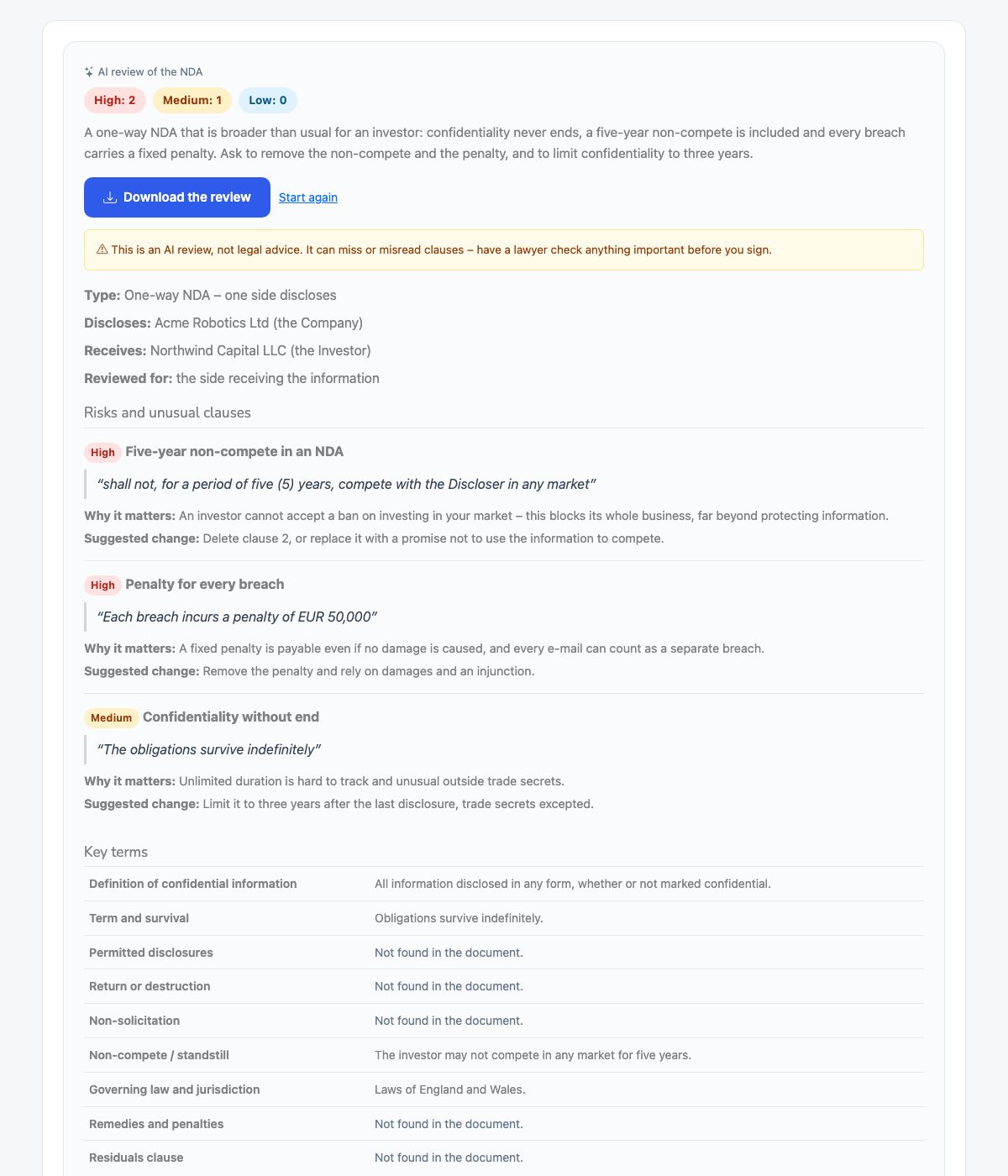
High, medium and low risks with the exact quote, why it matters and the change to ask for, then the key terms.
Negotiate, then sign
Send your changes, and have a lawyer check anything important – the review is not legal advice.
Agreed on the NDA? Require it before anyone opens your data room
Paste the final NDA into HelpRange once and switch it on for a data room or link: every guest verifies their e-mail and signs it before the first document opens, and you see who read what. Included in the Max plan ($87 per team per month).
Most NDAs look alike, which is exactly why the unusual clause gets signed without a second look: a non-compete hidden in a confidentiality agreement, a definition that covers everything ever said, confidentiality that never ends, or a penalty for every breach. Reading it once with a list of what to check takes a few minutes and saves a negotiation later.
What the AI NDA review checks
The review reads the whole agreement and reports the points that decide how much an NDA really costs you: whether it is mutual or one-way and who discloses; how confidential information is defined (and whether it must be marked); the term and how long confidentiality survives; who you may share information with; return or destruction at the end; non-solicitation and non-compete clauses hidden in a confidentiality agreement; governing law and courts; penalties, liquidated damages and indemnities; and the residuals clause that lets the other side use what its people remember.
Each risk comes with the exact words from the NDA, so you can find the clause in seconds, and a concrete change to ask for.
Disclosing or receiving – why your side matters
- If you disclose (a founder pitching, a seller in M&A), you want a broad definition, a long enough term, few permitted recipients, no residuals clause and a clear right to an injunction.
- If you receive (an investor, a buyer, a contractor), you want the standard exclusions, a fixed end date, the right to share with advisers and financing sources, no non-compete and no penalty per breach.
Need a balanced starting point instead? Create one with the free NDA generator, and once it is signed, require it before anyone opens your data room. For other agreements use the AI contract review.
Free AI NDA review – questions
Is this legal advice?
No. The AI points out what to look at and what to negotiate; it can miss or misread clauses. Have a lawyer check anything important before you sign.
Is it free?
Yes – 3 AI reviews a day per person (NDA and contract reviews together), PDF or Word up to 10 MB, no sign-up.
Is my NDA stored or used for training?
No. The text is sent to the AI for this review only and is not stored by HelpRange; only a usage counter is kept for the daily limit.
In which language is the review?
In the language of this page – switch the site language to get the review in another language. Quotes stay in the language of the NDA.
What does a residuals clause mean?
It lets the receiving side use ideas and know-how its people keep in their unaided memory. It is common in agreements with large technology companies and weakens the protection for the side that discloses.
Should an NDA contain a non-compete?
Usually not. A confidentiality agreement protects information; a ban on working in your market or with your customers is a much bigger commitment and is often flagged as a high risk.