PDF Tracking: How to Track a PDF in 2026
Opens, pages read, time, downloads and forwarding – which methods really track a PDF, what each one can see, and how to set it up.
Updated 8 November 2026. Disclosure: HelpRange is our product; the comparison applies to any tracking tool.
Can you track a PDF? Yes – but only through a link or a service, not through the file itself once it has been downloaded. A PDF is a file: when it sits on someone’s laptop or phone it opens in a reader you do not control, and most readers block the scripts and remote calls that “tracking PDFs” rely on. PDF tracking works when you share the PDF as a link to an online viewer: the service records every open and, in dedicated tools, which pages were read, for how long, whether the file was downloaded and whether the link was passed on.
What PDF tracking can show
“Tracking” covers six different things. Most methods give you one or two of them; check which ones you actually need before choosing a tool.
- Opens – that the document was opened, and when.
- Who – the reader’s e-mail or the name you gave their link.
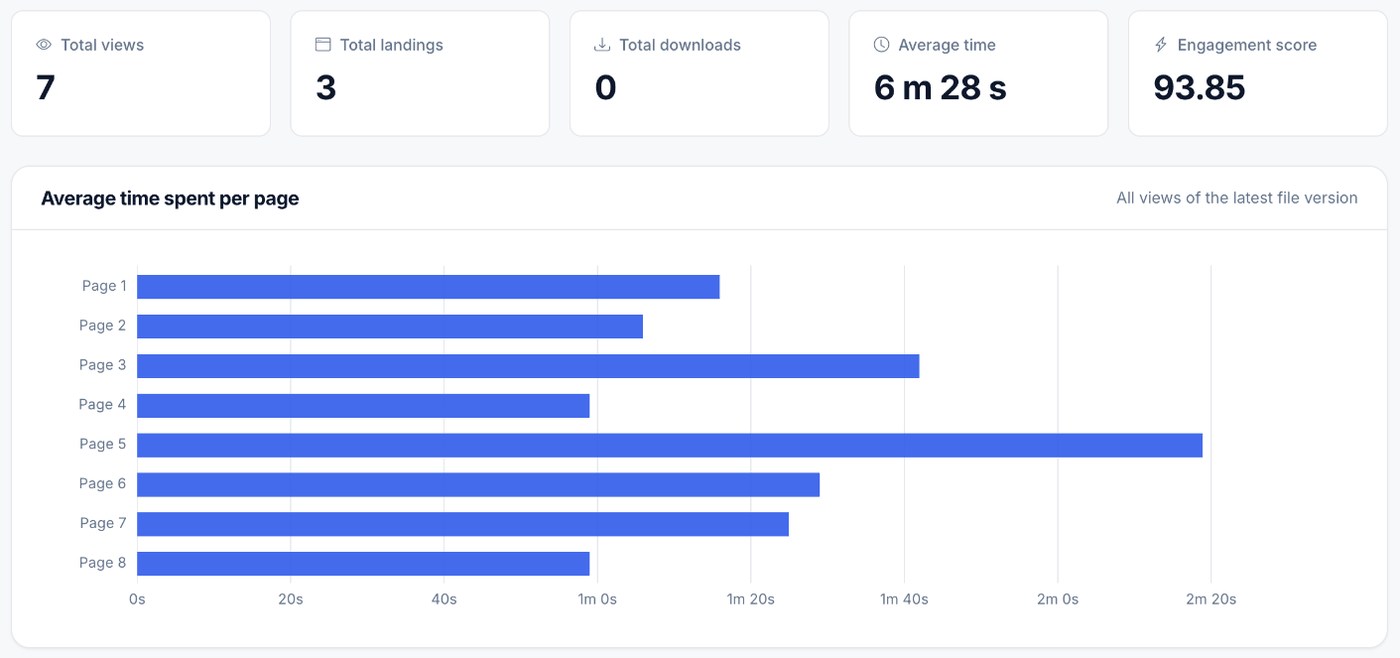
- Pages and time – which pages were read, skipped or re-read, and for how long.
- Downloads – whether the file left the viewer as a PDF.
- Forwards – whether new people opened the same document.
- Location and device – country (from the IP address), device and browser.
If all you need is an alert the moment someone opens your PDF, read our shorter guide on how to see who opened your PDF.
Ways to track a PDF, compared
| Method | Opens | Pages and time | Downloads | Forwards | Location | Limits |
|---|---|---|---|---|---|---|
| Tracked link tool (HelpRange, DocSend, Papermark and others) | Yes, every open | Yes – time per page; heatmaps in some tools | Yes, when you allow downloads | Yes – new viewers on the same link; can be blocked | Country, device | Recipients read in a browser; after a download the copy is no longer tracked |
| E-mail tracker (open pixel – Mailtrack, Mailsuite and similar) | Of the e-mail, not of the PDF | No | No | No | Sometimes | Mail apps preload images, so “opened” is often wrong; an attached PDF is never tracked. Mailsuite’s document tracking works only when the PDF is sent as a link |
| Adobe Acrobat shared link | Yes – notification and number of viewers | Not described by Adobe | Not described by Adobe | Viewers counted | No | Needs a paid Acrobat plan; no page-level analytics on Adobe’s help pages |
| Google Drive (Activity dashboard) | Who viewed and when – Docs, Sheets and Slides only | No | No | Only signed-in viewers in your organisation | No | Work or school accounts only; not for PDFs; viewers can turn view history off |
| JavaScript or remote image inside the PDF (“phone-home”) | Sometimes | No | No | Unreliably | IP address, if it works | Blocked or warned about by most readers (browsers, Preview, mobile apps); looks like malware to security filters |
| Web analytics on your site (GA4, server logs) | Clicks on the PDF link | No | Yes – file downloads | No | Country | Anonymous; only for PDFs hosted on your website |
Tracked link tools
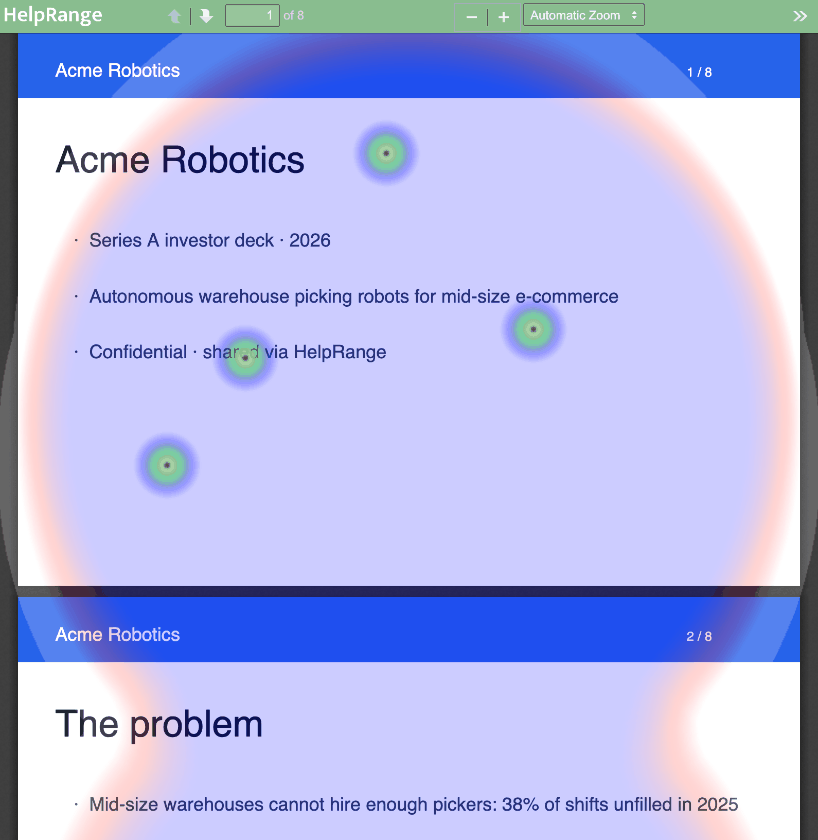
You upload the PDF and send a link instead of the attachment. The reader opens it in a web viewer, which records each visit, time on every page and – if you allow them – downloads. You can ask for the reader’s e-mail, confirm it with a one-time code, or create one link per recipient. This is the only method that shows pages and time. Tools differ in price and extras: DocSend starts at $10 per user per month (yearly), Papermark Pro at €24 (≈ $26) a month (yearly) and HelpRange Pro at $39 a month for the whole team (see DocSend alternative for sourced prices). HelpRange adds a page heatmap, a replay of each visit and an engagement score from 0 to 100 for every reader – see page-by-page document analytics.
E-mail trackers
E-mail trackers add an invisible image to the e-mail and tell you when that image loads. That is the e-mail being opened, not the PDF – and since Apple Mail Privacy Protection and Gmail’s image proxy load images automatically, “opened” is often reported when nobody read anything. A PDF attached to the e-mail is not tracked at all. Mailsuite (formerly Mailtrack) says so itself: to track a document, it must be sent as a link to Mailsuite’s viewer, not attached; then you see opens, downloads and time per page (Mailsuite help). Tracked PDFs are limited to 5 documents on the Free and Mailtrack plans and unlimited on the Mailsuite plan at €5.99 (≈ $7) per user per month (Mailsuite pricing, checked 8 November 2026). In other words, it is a tracked link inside Gmail.
Adobe Acrobat and Document Cloud
When you share a PDF from Acrobat as a link, Adobe notifies you in Acrobat and by e-mail when a recipient views it, and the “Shared by you” list shows how many people viewed the file (Adobe: manage shared documents; recipients can open link-shared files in a browser without signing in, per Adobe: share via links). Link sharing and review are listed under Acrobat Standard and Pro on Adobe’s pricing page. Adobe’s help pages do not describe time per page, page heatmaps or download tracking for shared links (checked 8 November 2026). Good enough to know a reviewer looked; not enough to see what they read.
Google Drive
Google’s Activity dashboard lists who viewed a Google Docs, Sheets or Slides file and when. It works only for files owned by a work or school account, only for signed-in viewers, and each user can turn off their view history; it shows no time spent or pages (Google: see who viewed a file, Google Workspace admin help, checked 8 November 2026). A PDF stored in Drive has no viewer list. More in how to track a Google Doc.
“Phone-home” JavaScript in the PDF
The PDF format can carry JavaScript and links that call a server when the file opens. In practice Chrome’s and Firefox’s built-in viewers, Apple Preview and most mobile readers do not run that code, and Acrobat shows a security warning before connecting to the internet. You get a signal from a minority of readers – and your file looks like a phishing attachment to mail filters. We do not recommend it.
Web analytics for PDFs on your website
If the PDF is a download on your own site (a brochure, a white paper), Google Analytics 4
records a file_download event for links to .pdf files when enhanced measurement is
on (Google
Analytics help). You learn how many people downloaded it, not who they were or whether
they read it. To capture names, put the PDF behind a short form – see
PDF lead magnets.
How to track a PDF step by step (HelpRange)
About five minutes; the free plan is enough to try it.
- Upload the PDF to a folder. Word, PowerPoint and Excel files are converted, so every page can be tracked.
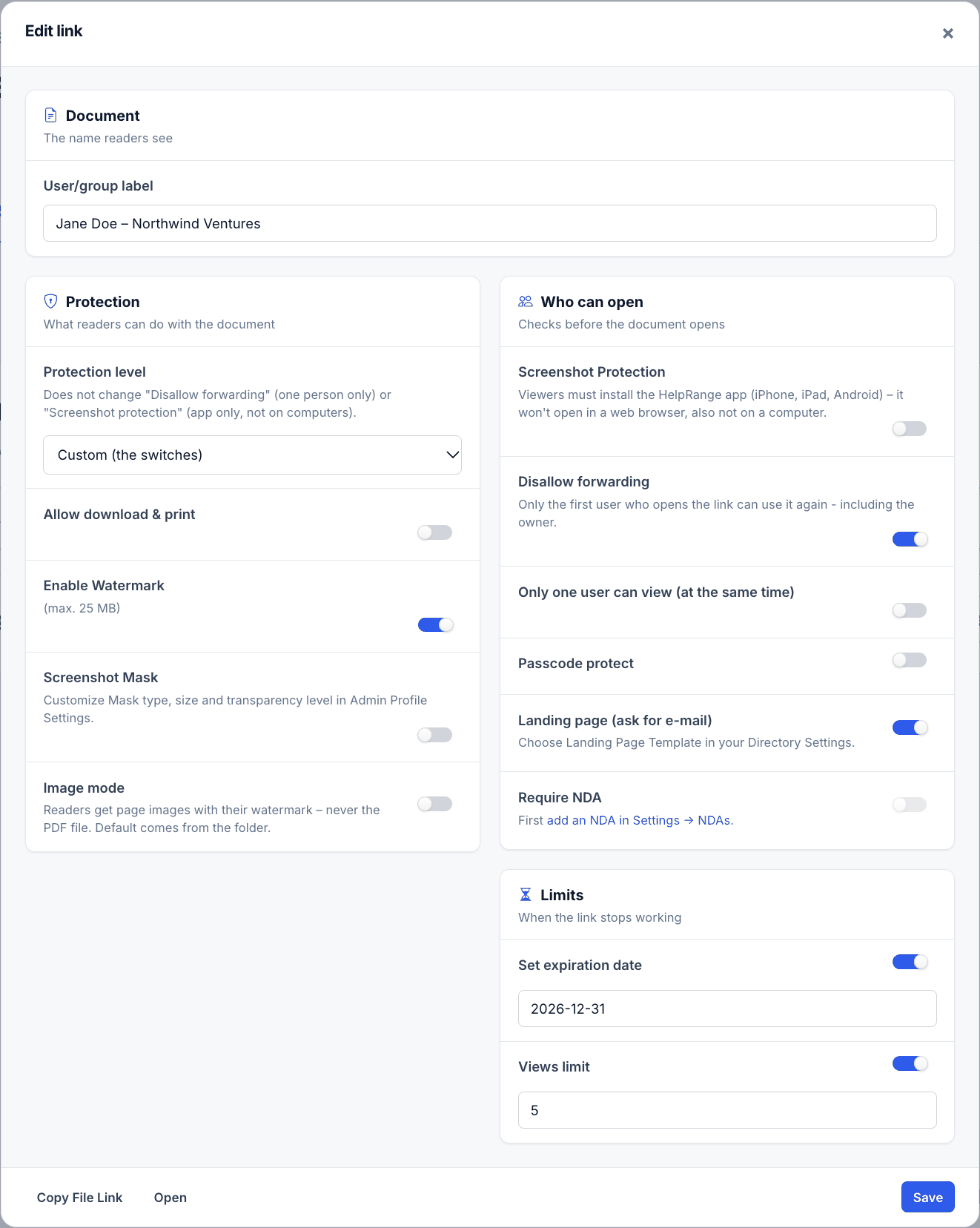
- Create a link and give it a label – e.g. the recipient’s name and company. One link per recipient tells you who is who without asking for an e-mail.
- Choose who can open it: turn on Landing page (ask for e-mail) to get each reader’s address, a passcode, Disallow forwarding so only the first reader can use the link, an expiration date or a views limit.
- Decide on downloads: leave Allow download & print off to keep the reader in the tracked viewer, or turn it on and see who downloaded.
- Send the link instead of the attachment – by e-mail, chat or CRM.
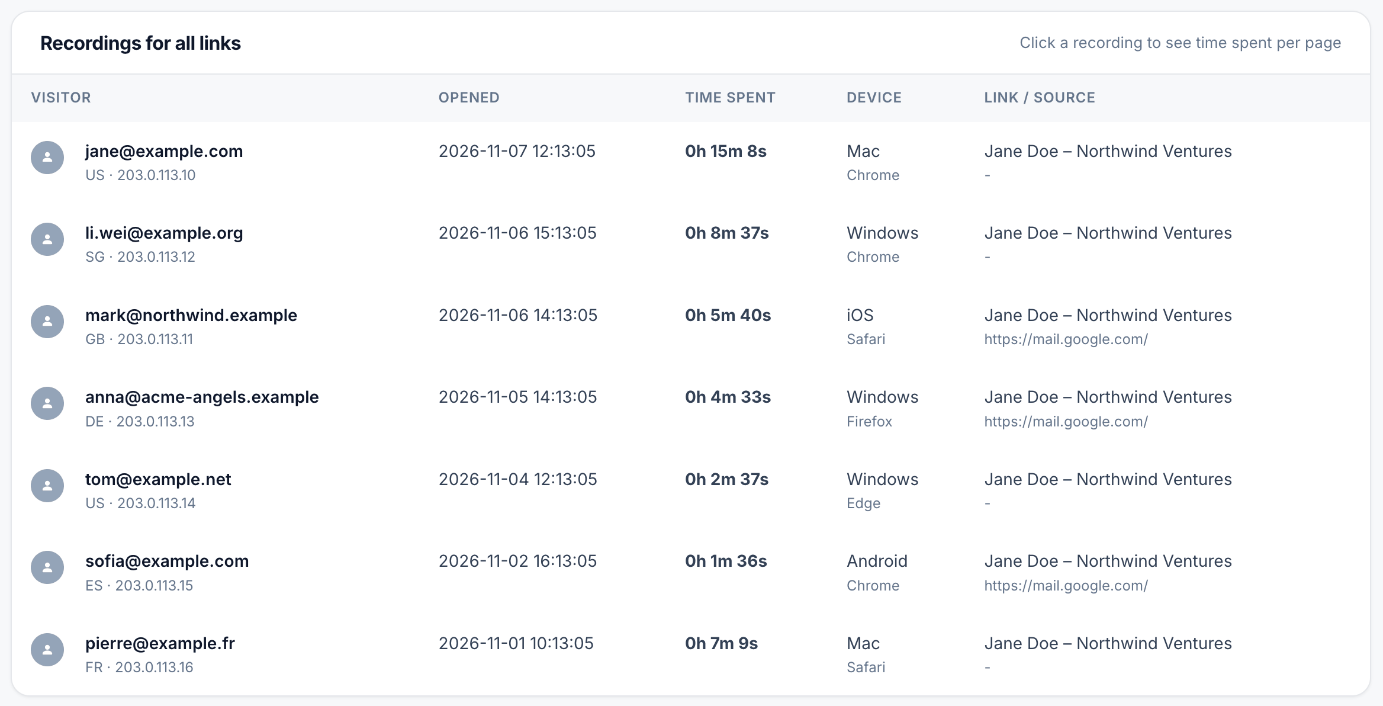
- Watch the analytics: every visit, time on each page, the heatmap, downloads – and an e-mail, Slack message or webhook when the document is opened (Slack and webhooks).
Sending proposals or quotes? The sales setup – one link per client, alerts and follow-up timing – is on proposal tracking. Tracking is on the free plan: see when a PDF is read.
How to track PDF downloads and views
Views
A view is counted when the PDF opens in the viewer. In a tracked link tool each view is a visit with its own time per page, so you can tell a 5-second glance from a 15-minute read. Repeat visits matter more than the first one: a client who comes back to the pricing page is deciding.
Downloads of a PDF you send
Turn on Allow download & print for the link. HelpRange marks the visits that downloaded the file and shows a download count for the link and the document (the “Total downloads” tile above). What happens to the downloaded copy afterwards cannot be tracked – so for confidential files keep downloads off, or add a watermark with the reader’s e-mail so any copy shows whose it was.
Downloads of a PDF on your website
Use GA4’s file_download event or your server logs (see above). For named
downloads, gate the PDF behind an e-mail form.
Can you tell if a PDF was forwarded?
An attached PDF: no. A link: yes – a forwarded link shows up as a new viewer (a new e-mail, a new device or country on a one-person link). If forwarding should not happen at all, require a confirmed e-mail or turn on Disallow forwarding, which lets only the first reader use the link. To end access automatically, set an expiry date or a view limit on the link. More in how to restrict who can open a PDF.
Privacy and GDPR
Tracking how a named person reads a document is processing of personal data under the GDPR (EU) and UK GDPR. In practice:
- Tell recipients. A line in your e-mail (“shared through HelpRange, which records views”) or an e-mail gate on the link makes the tracking visible.
- Have a lawful basis. For business documents sent to a contact this is usually legitimate interest; document it.
- Collect only what you need and keep it for a limited time; delete links and analytics when the deal or project is over.
- Do not hide trackers in files. Scripts that call home without the reader knowing are hard to justify and are treated as suspicious by mail filters.
This is general information, not legal advice.
Which method to choose
- You need to know what a client or investor read (pages, time, repeat visits): a tracked link tool.
- You only need to know an e-mail was opened: an e-mail tracker – but do not rely on it for the attachment.
- Internal review of a draft: Acrobat shared links or, for Google files, the Activity dashboard in Workspace.
- Downloads from your website: GA4 or server logs.
Tracking documents across a whole team or company? See what a document tracking system is, with software prices.
Send it as a protected link instead
Upload the document and send a link, not the file: readers confirm their e-mail before it opens, download and printing are blocked, every page carries a watermark with the reader's e-mail, the link can expire or be revoked at any time, and you see who read which page.
Protection is part of Pro ($39 per team a month, free trial first); the Free plan keeps tracked links without protection.
FAQ
Can you track a PDF file?
Yes, but only through a link or a service, not through the file itself. If you share the PDF as a link to an online viewer (HelpRange, DocSend, Adobe Acrobat shared links, Google Drive in Workspace), the service records opens and, in dedicated tools, pages read, time and downloads. A PDF file that has been downloaded or attached to an e-mail cannot be tracked reliably: most PDF readers block the scripts and remote calls that tracking would need.
Can you track a PDF after it has been downloaded?
No, not reliably. Once the file is on someone’s device it opens in a reader you do not control, and copies can be passed on without you knowing. You can record the download itself, and a watermark with the recipient’s e-mail makes a leaked copy traceable to its source. To keep tracking, switch downloads off and share a view-only link.
How do I track PDF downloads?
For a PDF on your own website, Google Analytics 4 enhanced measurement records a
file_download event for .pdf links; your server logs also show each request. For a
PDF you send to people, share it as a tracked link that allows downloads: HelpRange records
which visit downloaded the file and counts downloads per link.
Can Adobe Acrobat track who viewed my PDF?
Partly. When you share a PDF as a link from Acrobat, Adobe notifies you when a recipient views it and shows how many people viewed the file in your shared files list. Adobe’s help pages do not describe time per page, page heatmaps or download tracking for shared links.
Can I see who viewed a PDF in Google Drive?
Not for a PDF. Google’s Activity dashboard lists viewers of Google Docs, Sheets and Slides, only for work or school accounts, only signed-in viewers, and users can turn off their view history. It does not show time spent or pages read.
Is it legal to track a PDF?
Yes, if you are open about it. In the EU and UK, reading analytics tied to a person are personal data under the GDPR: tell recipients the document is shared through a tracking service, collect only what you need, keep it for a limited time and have a lawful basis such as legitimate interest.
Is there a free way to track a PDF?
Yes. The HelpRange Free plan gives tracked links with page-by-page analytics for up to 15 document views a month. Passcodes, e-mail verification, expiry and blocking downloads are part of Pro at $39 per team per month – see pricing.