Startup valuation calculator
See the pre- and post-money valuation implied by your round, and how it compares with a multiple of your recurring revenue.
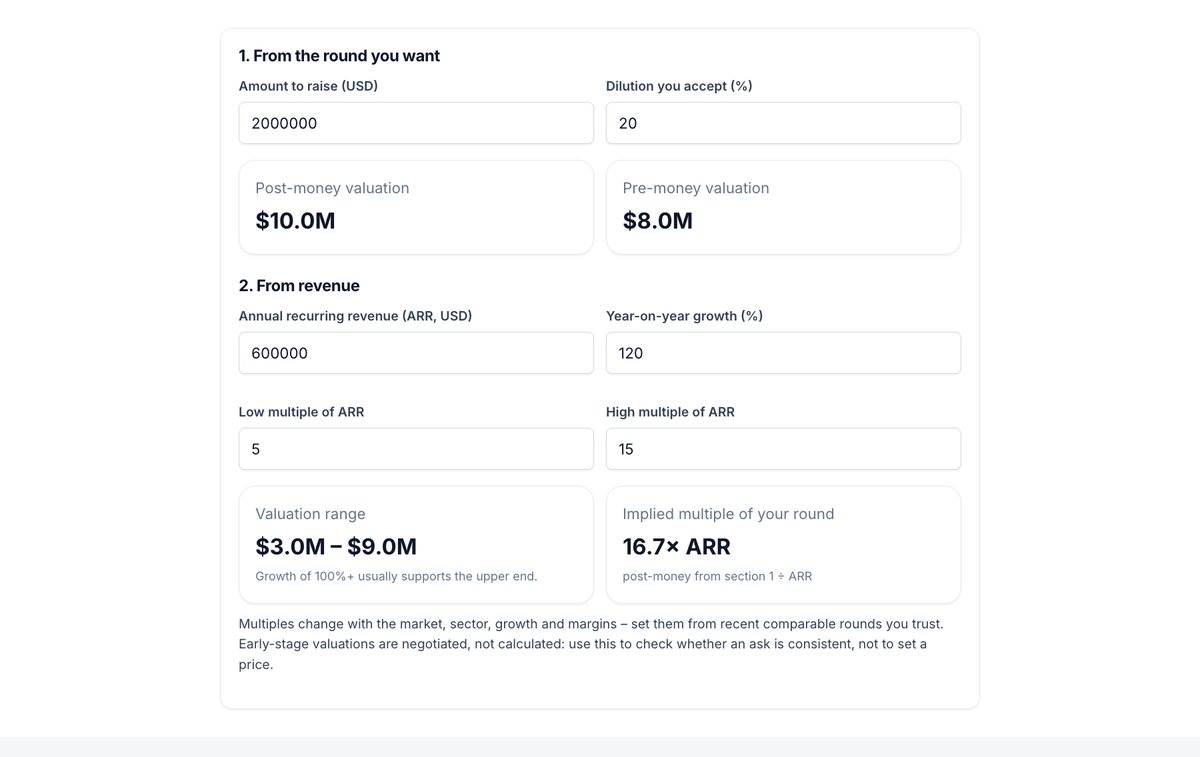
1. From the round you want
2. From revenue
Multiples change with the market, sector, growth and margins – set them from recent comparable rounds you trust. Early-stage valuations are negotiated, not calculated: use this to check whether an ask is consistent, not to set a price.
How it works
Enter the round you want
How much you raise and how much dilution you accept.
Enter revenue and growth
Annual recurring revenue and year-on-year growth.
Compare the two views
The valuation your ask implies, next to a range of revenue multiples.
Embed this startup valuation calculator on your website (free)
Copy the code into your page or blog post. The tool runs in your visitors' browser; keep the credit line.
Back your valuation with a deck investors actually read
HelpRange shows which investors opened your deck, which slides they studied and who forwarded it – so you know where the interest is.
Early-stage valuation is negotiated, but the math behind it is simple. Checking that your raise, dilution and revenue tell one consistent story makes the conversation with investors shorter.
Two quick ways to sanity-check a valuation
From the round: post-money = amount raised ÷ dilution. Raising $2M for 20% implies a $10M post-money and an $8M pre-money valuation. Seed rounds usually sell 15–25%, Series A 15–25% too.
From revenue: recurring-revenue businesses are often compared with a multiple of ARR. Faster growth, better margins and net revenue retention justify higher multiples; the right range changes with the market, so take it from recent comparable rounds. If your ask implies 40× ARR while comparable companies raise at 10–15×, expect pushback – or have a strong reason ready.
Before you set a number
- Early-stage valuations are negotiated, not calculated: competition between investors moves them more than formulas.
- Check how existing SAFEs and the option pool dilute you with the SAFE & cap table calculator.
- Raise enough for 18–24 months of runway – the burn rate calculator shows how much that is.
Example
You want to raise $3M and give up 20%: that is a $15M post-money and $12M pre-money valuation. With $1M ARR it is 15× revenue. If comparable companies growing at your rate raised at 8–12×, either show why you are different – faster growth, better retention – or adjust the amount or the dilution.
Startup valuation calculator – questions
What is the difference between pre-money and post-money?
Post-money = pre-money + the new money. If you raise $2M for 20%, the post-money is $10M and the pre-money $8M.
Which multiple should I use?
Use recent rounds of comparable companies (sector, growth, margins). Multiples move with the market, so the calculator lets you set them.
Can pre-revenue startups use it?
Yes – the round section works without revenue; for pre-revenue companies valuation is driven by team, market and traction.
How is a SaaS startup valued on ARR?
As a multiple of annual recurring revenue: valuation = ARR × multiple. The multiple comes from comparable companies and rises with growth, gross margin and net revenue retention. Enter a low and a high multiple to see the range, and compare it with the valuation your round implies.