Exit waterfall calculator
Enter the cap table and an exit value to see who gets how much – liquidation preferences, participation, conversion to common, options and SAFEs included.
Simplified model: it ignores taxes, transaction fees, escrow, management carve-outs and dividends. Each preferred series converts to common only when that pays it more. Not legal or tax advice.
How it works
Start from the example
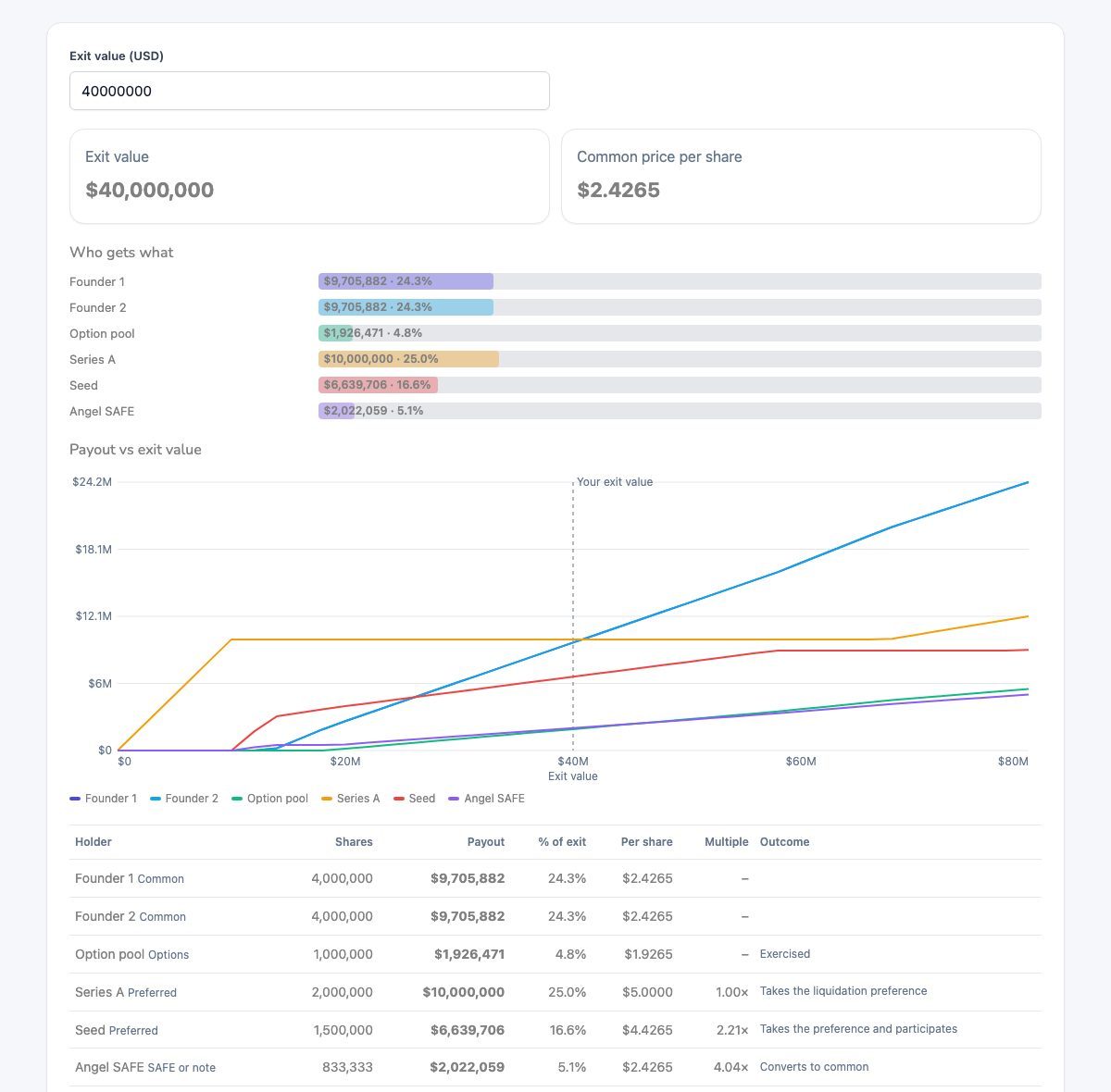
The calculator opens with a realistic cap table and a $40M exit, so you see a result at once.
Enter your cap table
Common shareholders, the option pool, each preferred series with its preference, participation, cap and seniority, and any SAFEs or notes.
Set the exit value
See who gets how much, the price per common share, and which series convert to common.
Share the scenario
Copy the link – the numbers are in the URL, nothing is stored – or download the table as CSV.
Embed this exit waterfall calculator on your website (free)
Copy the code into your page or blog post. The tool runs in your visitors' browser; keep the credit line.
Preparing an exit? Run the sale in a data room
Share the teaser as a tracked link, then open an M&A data room with NDA before access, Q&A and a log of which buyer read what – one flat price per team.
The headline price of an exit is not what founders and employees receive. Preferences, participation and seniority decide the order of payment, and at modest exit values they can leave common shareholders with far less than their percentage suggests. Modelling the waterfall before you agree terms shows what each clause is worth.
How an exit waterfall works
When a company is sold, the money is paid in a fixed order. Preferred series are paid their liquidation preference first – usually 1× the money they invested – starting with the most senior series; series with the same seniority share pro rata (pari passu). What is left goes to common shareholders, option holders and any series that converted to common.
A non-participating series takes the greater of its preference and its share as if converted, so at high exit values it converts. A participating series takes its preference and then also shares in the rest – up to its cap, if there is one; above the cap it is better off converting. Options are exercised only when the price per share is above their exercise price.
What to look at
- The chart shows the exit value at which common shareholders start receiving meaningful money – often far above the total invested.
- Compare a 1× non-participating preference with a participating one at the same valuation: the difference for founders can be millions.
- SAFEs convert at their valuation cap or take their money back, whichever is more.
- Model the round before you sign the term sheet with the SAFE & cap table calculator and the valuation calculator.
Exit waterfall calculator – questions
What is a liquidation preference?
The right of preferred shareholders to get their money back (or a multiple of it) before common shareholders receive anything when the company is sold.
What is the difference between participating and non-participating preferred?
Non-participating preferred takes either its preference or its share as if converted to common – whichever is more. Participating preferred takes its preference and then also shares in the rest, unless a cap limits it.
Is my data stored?
No – the calculator runs in your browser. The link you share contains the numbers, nothing is saved on our servers.
Is this exact?
It is a simplified model: taxes, transaction fees, escrow, management carve-outs and accrued dividends are ignored. Check real distributions with your lawyer.
What does seniority mean?
The order in which preferred series are paid. Seniority 1 is paid first; series with the same number are paid at the same time, pro rata to their preferences (pari passu).
Why do founders sometimes get nothing in a sale?
If the exit value is lower than the sum of the liquidation preferences, the preferred shareholders take everything before common shareholders are paid.